


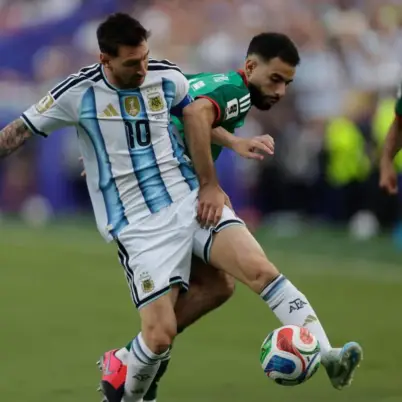
 When Messi was substituted at 37, Bangla Cricket Live could wait as he stayed by the touchline instead of heading straight to the dressing room, giving every teammate a high five and celebrating with them after the final whistle. When 41-year-old Ronaldo played the full match, the broadcast camera cut to him walking alone with his head down, saying nothing as he passed through celebrating teammates and went straight into the tunnel.
That was the clearest contrast between two football kings on the 2026 World Cup stage. It was not simply about declining technique or weaker numbers. It exposed the harshest truth inside any dressing room: when a superstar is no longer the strongest card for winning, he can be isolated and pushed aside.
Argentina’s opening goal in 2026 said everything. Messi received the ball near the center circle and instantly drew two defenders. Most stars would force a dribble or fire from distance, but Messi shaped as if he would drive forward, pulled the defense toward him, then slipped a perfectly weighted pass to the right so Molina could cross without breaking stride. Molina became part of the attack, not just a supporting extra.
That is the biggest difference. Ronaldo has often wanted teammates to serve as his backdrop, while Messi wants them to become partners. Inside Argentina, players are fully committed because Messi’s style gives everyone a role. Di Maria, Lautaro, Mac Allister, and Enzo all play around him, not just because he is called the core, but because they believe giving him the ball helps the team win.
The trust extends beyond the pitch. De Paul may have several passing lanes, yet he often chooses Messi by instinct because he trusts him to finish or shape the attack. Messi creates chances for teammates, and his assist numbers remain far ahead within the squad. After being taken off with Argentina leading 2-0, he did not disappear into the tunnel. He stood by the bench, greeted every teammate, waited for the match to end, then celebrated like a child.
That humility matters. It shows he sees himself as part of the team, not a god above it. Even after losing the 2014 World Cup final, Messi agreed to take a photo with Gotze while the German still had a World Cup gold medal around his neck. That level of grace is rare, even among the greatest players.
Ronaldo’s situation with Portugal tells a very different story. Against DR Congo, his touches fell to a new low, and few teammates seemed eager to pass to him. After the match, he did not join the team celebration. He returned to the dressing room alone, with almost no interaction. During the game, he repeatedly showed frustration when the ball did not arrive, openly complaining about the lack of cooperation.
The seed had already been planted at the 2022 World Cup in Qatar. Ronaldo sat on the bench while Portugal’s younger players flowed freely and beat Switzerland 6-1. A question quietly entered the dressing room: could we play better without him? Four years later, that seed has grown. Ronaldo no longer has the explosive first step that once left defenders behind.
Portugal now have Bernardo Silva, Bruno Fernandes, Leao, and Felix, players built for quick combinations, tight spaces, and constant passing movement. They need a striker who can drop deep, link play, drift wide, and lift the tempo with one-touch football. Ronaldo, however, is still a finisher who waits in the box for the final ball.
That creates the problem. His movement has always served the final shot, not the creation of space for others. Younger teammates face an awkward choice: pass to him and he can no longer solve everything alone, or skip him and risk the unhappy gestures, open arms, head shakes, and complaints. Negative energy spreads quickly, and eventually the younger generation votes with its feet.
Some fans have noted that Ronaldo spends a large share of matches in offside positions. While others sprint during transitions, he often walks ahead. When teammates are searching for fast passing combinations, a player waiting in place can become a speed bump in the attack.
Body language makes the leadership gap even clearer. When Ronaldo makes a mistake, he often spreads his arms, complains loudly, and shows frustration on his face. When Messi makes a mistake, he usually does not complain. He quickly returns to position, keeps his expression calm, and prevents emotion from disturbing his decision-making rhythm. Ronaldo’s body language says, give me the ball and I will solve it. Messi’s says, the game is still under control.
The numbers are even more painful. Messi has scored seven goals and provided five assists in World Cup knockout matches, making him one of the most productive players in that stage. From his calm penalty in the 2014 semifinal to scoring in the round of 16, quarterfinal, semifinal, and final in 2022, he directly contributed to 12 goals across 10 knockout matches.
Ronaldo’s World Cup knockout record stands at zero goals and zero assists across eight matches and 570 minutes. He took 29 shots and created nine chances, yet both key columns stayed empty. His eight World Cup goals all came in group matches. The hat trick against Spain in 2018 was unforgettable, but once the knockout rounds arrived, the drought was impossible to ignore.
The deeper reason is tactical. World Cup knockout opponents usually defend deep, leaving little sprinting space. Ronaldo’s greatest weapon depends on that space, while Messi’s game relies on touch, vision, and passing precision. Messi moved from right winger to false nine, then to all-around creator, and now to a wise field commander.
As the debate continues around Bangla Cricket Live, Messi’s ability to evolve is why he remains irreplaceable even in his late thirties. At Inter Miami, he produced 59 goals and 41 assists in 64 matches, directly contributing to more than 1.5 goals per game. Ronaldo is still a legend, but when the strongest card is no longer enough to win, football can be cold as ice.